



#1
S2E6
A Closet Full of Hell
Dharma and Greg find a secret room in their new apartment full of dolls and are spooked when two new dolls that look exactly like Dharma and Greg suddenly appear.

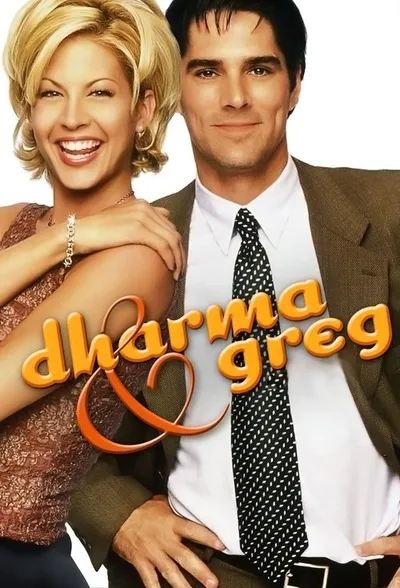
Dharma & Greg is an American television sitcom that aired from September 24, 1997, to April 30, 2002. It stars Jenna Elfman and Thomas Gibson as Dharma and Greg Montgomery, a couple who got married on their first date despite being complete opposites. The series is co-produced by Chuck Lorre Productions, More-Medavoy Productions and 4 to 6 Foot Productions in association with 20th Century Fox Television for ABC. The show's theme song was written and performed by composer Dennis C. Brown. Created by executive producers Dottie Dartland and Chuck Lorre, the comedy took much of its inspiration from so-called culture-clash "fish out of water" situations. The show earned eight Golden Globe nominations, six Emmy Award nominations, and six Satellite Awards nominations. Elfman earned a Golden Globe in 1999 for Best Actress.

Regional listings, not a guarantee of subscription access.
The peaks and the valleys. Find the essential episodes — and the ones to skip.
Dharma and Greg find a secret room in their new apartment full of dolls and are spooked when two new dolls that look exactly like Dharma and Greg suddenly appear.
A culturally mismatched couple find love at first sight. They meet on a subway and decide to wed immediately. That done, it's a matter of dealing with the in-laws.
To win a bet with Jane, Dharma and Greg plan to have sex in a public locale while the finale of Seinfeld distracts the city.
Dharma tries to help Marlene's loneliness by fixing her up on a date with a guy Greg doesn't approve of. Pete moves in with them after his divorce.
Each point is an episode, plotted in order. Colored bands mark season boundaries. Look for the rise, the plateau, or the decline.
High votes + high rating = beloved classic. High votes + low rating = notorious stinker. Low votes + high rating = hidden gem.
One point per season. Smooths out the episode-to-episode noise to reveal the bigger arc.
Did each season build or fizzle? Green means the finale outscored the premiere. Red means the opposite. Longer arrows, bigger swings.
How steady is each season? Tightly clustered dots mean reliable quality. Scattered dots mean a wild ride.
Connection lost