


#1
S5E2
Bad Blood: Part 2
Dwayne becomes increasingly withdrawn as he awaits the results of his HIV test. Meanwhile, Michelle finds out the real reason B.L.T. broke up with her.

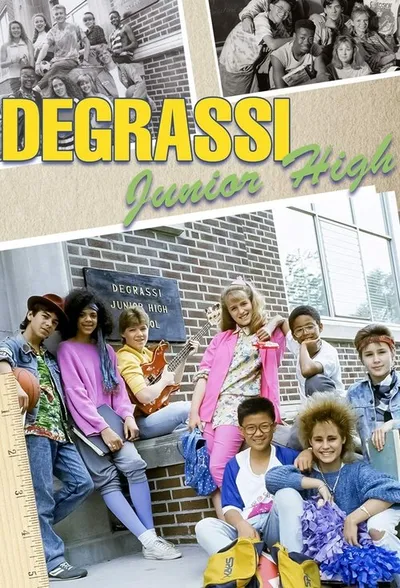
Degrassi Junior High is a Canadian CBC Television teen drama series that was produced from 1987-1989 as part of the Degrassi series. The show followed the lives of a group of students attending the titular fictional school. Many episodes tackled difficult topics such as drug use, child abuse, teenage pregnancy, homosexuality, homophobia, racism, and divorce, and the series was acclaimed for its sensitive and realistic portrayal of the challenges of teenage life. The cast comprised mainly non-professional actors, which added to the show's sense of realism. The series featured many of the same actors who had starred on The Kids of Degrassi Street a few years earlier, including Stacie Mistysyn, Neil Hope, Anais Granofsky, Sarah Charlesworth and others. However, their character names and family situations had been changed, so Degrassi Junior High cannot, therefore, be considered a direct spinoff. The legal counsel for all the episodes was Stephen Stohn who later became the executive producer of Degrassi: The Next Generation. The series was filmed at the unused Vincent Massey Public School in Etobicoke, Ontario.

Regional listings, not a guarantee of subscription access.
The peaks and the valleys. Find the essential episodes — and the ones to skip.
Dwayne becomes increasingly withdrawn as he awaits the results of his HIV test. Meanwhile, Michelle finds out the real reason B.L.T. broke up with her.
The whole school is thrown into turmoil when a student commits suicide at school--especially Caitlin, since the student is her ex-boyfriend Claude.
Life begins to go on at Degrassi, but should they go through with Talent Night? Meanwhile, Caitlin begins to have nightmares about Claude's suicide.
Arthur and Yick exchange gifts for Christmas. When Yick assumes that Arthur spent more money on his gift, they get into an arguement. The two friends remember all that they have been through together, and become friends again.
Each point is an episode, plotted in order. Colored bands mark season boundaries. Look for the rise, the plateau, or the decline.
High votes + high rating = beloved classic. High votes + low rating = notorious stinker. Low votes + high rating = hidden gem.
One point per season. Smooths out the episode-to-episode noise to reveal the bigger arc.
Did each season build or fizzle? Green means the finale outscored the premiere. Red means the opposite. Longer arrows, bigger swings.
How steady is each season? Tightly clustered dots mean reliable quality. Scattered dots mean a wild ride.
Connection lost